Most people don’t lack the desire to look after themselves. They lack a space that makes it easy to start.
You buy the yoga mat. You download the meditation app. You genuinely mean to use them. But the mat stays rolled up behind the wardrobe, the app sits unopened, and another week passes. The problem is rarely motivation. It’s friction. When your wellness practice requires you to move furniture, hunt for equipment, or negotiate a corner of a room that’s already doing three other jobs, starting feels like effort before you’ve even begun.
A dedicated wellness space changes that. Research shows that intentionally designed personal spaces significantly reduce stress and support better mental wellbeing. You don’t need a spare room or a large budget. You need somewhere that’s ready when you are.
Start With the Right Spot in Your Home
Before you think about equipment or how the space looks, think about location. Where you put your wellness space will decide whether you actually use it.
The most important factor is visibility. A space tucked away in a room you rarely enter will quietly disappear from your routine within a couple of weeks. A corner of your bedroom, a section of the living room, or an alcove on the landing somewhere you pass through every day keeps the habit front of mind without requiring any extra thought.
Beyond that, look for natural light where possible, a spot that’s reasonably quiet, and somewhere you can get started quickly. If it takes more than a minute to be in space and ready to go, it’s probably too far away.
Different Kinds of Wellness Spaces you Can Create
A wellness space doesn’t need to be a purpose-built studio. It’s any area in your home that you’ve made intentional. Here are the most practical options depending on what you have available:
A Yoga or Movement Corner
It needs roughly two metres by one and a half metres of clear floor. Keep your mat unrolled and within reach, and make sure the area stays clear between sessions. A space that’s ready to use is a space that gets used.
A Meditation Nook
Meditation nook can be as small as a comfortable chair and a side table. Add a candle or a pair of headphones and keep everything else out. The simplicity is deliberate. It tells your brain this spot is for slowing down.
A Reading or Breathwork Space
These work well near a window or anywhere with good natural light. A floor cushion, a low chair, or even a window seat is enough. This is the quieter, more restorative end of wellness and it doesn’t need much.
A Home Gym Corner
A home gym doesn’t require a full room. A kettlebell, resistance bands, and a mat stored visibly in a bedroom corner or garage can support a genuine training habit. The key is keeping everything out and accessible rather than packed away.
Start with one. A space you use consistently is worth far more than an elaborate setup that collects dust.
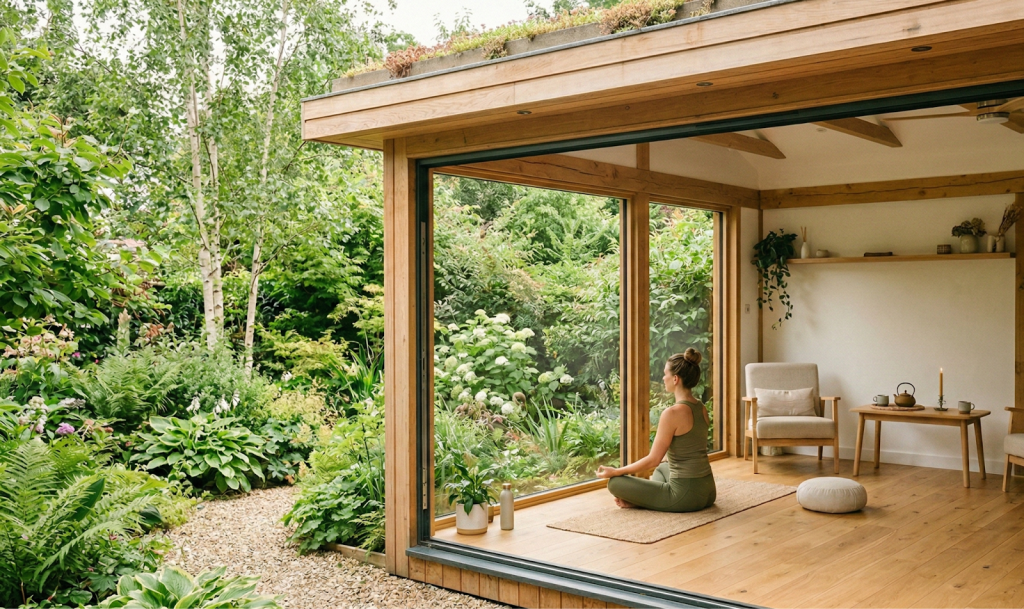
An Outdoor Garden Studio
A dedicated outdoor studio means your wellness space isn’t competing with the rest of the house for space or attention. Large windows bring in natural light and garden views, both of which support a calmer, more focused session. And because space has one purpose, it becomes much easier to treat it that way.
For a permanent, well-built solution, Elfords timber buildings design and build bespoke timber garden buildings across the South of England. They’ve been doing it since 1982 and make everything in-house, so the quality holds up for the long term. If you’re serious about having a space that genuinely becomes part of your routine, a garden studio is one of the most effective ways to make that happen.
In Conclusion
Attach your wellness session to something you already do, a morning coffee, the end of the working day, or the twenty minutes before your evening shower. Familiar anchors make new habits far easier to maintain than open-ended intentions.
Lower the bar to begin. Tell yourself five minutes is enough. That’s it. You’ll often do more once you’ve started, but removing the pressure to complete a full session makes showing up significantly easier on the harder days.
Keep the space visible and ready between sessions. A mat left unrolled, a candle already in place, a cushion already positioned, these small details do quiet motivational work every time you walk past.
The space you’ll actually use isn’t the most impressive one. It’s the one that’s easy to get to, welcoming when you arrive, and waiting for you without any fuss.